
Contractor guide · Job sites in Luxembourg
Working in Luxembourg: how to house your whole crew on the French side without blowing the budget
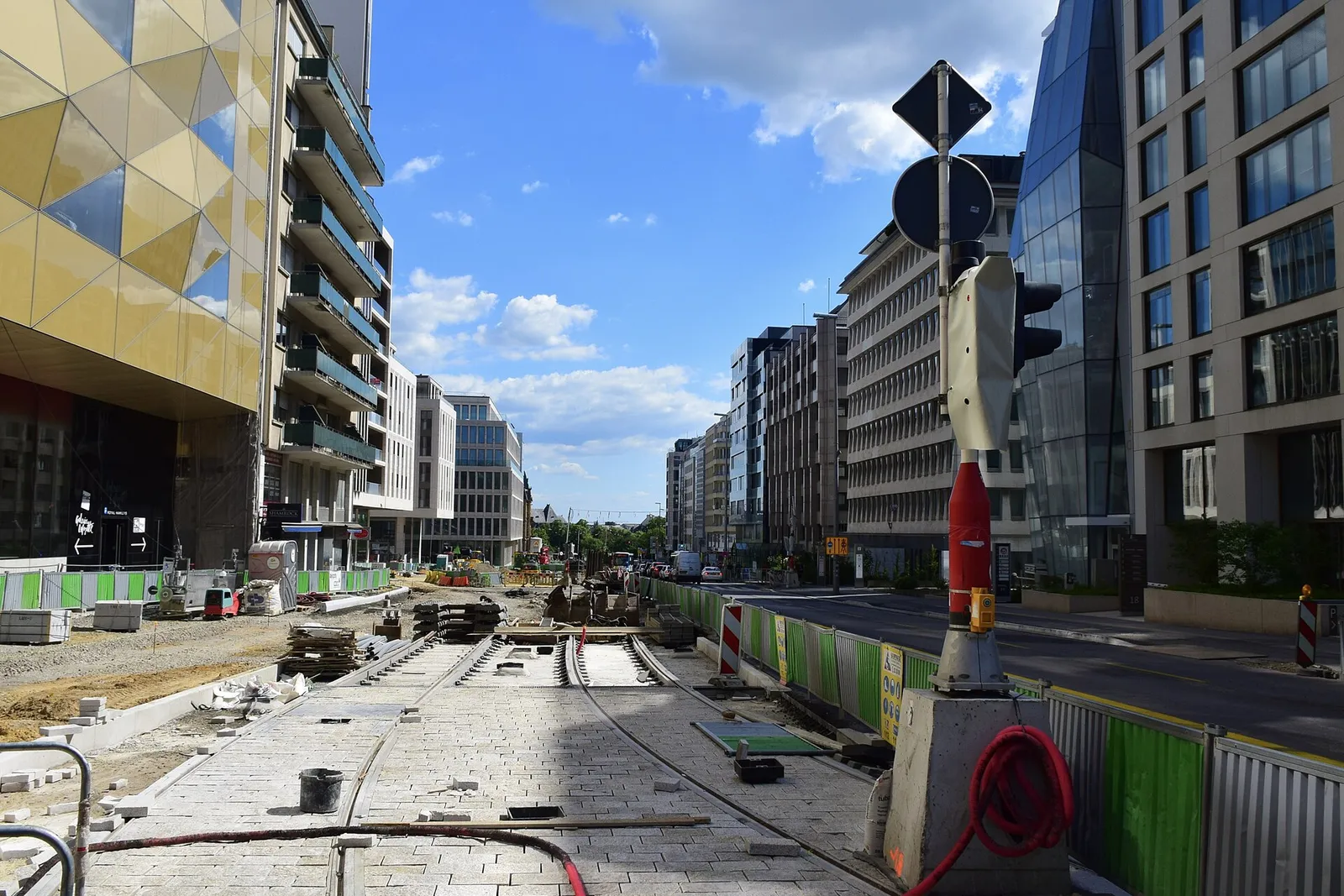
The contract is signed: six weeks of installation work in Luxembourg, maybe three months if the client adds a phase. You start looking for rooms near the site… and the only hotels with availability are priced for bankers at a conference.
Site manager, project lead, company owner or the office assistant who has to "find beds by Monday": you're not alone. Construction firms, industrial maintenance contractors, crane and steel erection crews all run into the same wall. The answer most of them land on fits in one line: work in Luxembourg, sleep in France. Here's how to do it properly.
Why worker accommodation in Luxembourg is so expensive
Luxembourg is a small country packed with banks, EU institutions and company headquarters. Hotels around the business districts are built for guests who travel alone, on weekdays, on an expense account. Not for a crew of twelve fitters staying two months.
What that means on the ground:
- Prices set for business travellers, climbing further whenever a trade fair or big event fills the city.
- Fully booked hotels exactly when you need several rooms for several weeks.
- A crew split across three hotels: three addresses, three breakfast times, and a foreman spending his evenings on the phone.
- No kitchen: eating out every night, and the per diem is blown by week two.
- No washing machine for work clothes covered in dust, grease or concrete.
There's a reason about 126,600 residents of France crossed the border to work in Luxembourg in 2025 (AGURAM figures): living on the French side is simply what the whole region does. More on that in work in Luxembourg, live in France.
Hotel vs apartment: where the savings come from
You don't need a complex spreadsheet. It's all in how you pay.
| Hotel near the site | Apartment on the French side | |
|---|---|---|
| Billing | Per room, often per person | Per apartment, for the whole group |
| Meals | Restaurant or takeaway every night | Equipped kitchen, shared groceries |
| Work clothes | Laundromat | Washing machine on site |
| The crew | Often scattered | Together, with a shared living room |
| Dates slip | Renegotiate every room | One contact, one booking to change |
With a hotel, cost rises with every extra worker. With an apartment, the price is shared by everyone sleeping there, and the kitchen turns dinners into a supermarket run. On a job lasting several weeks, that's often where your margin lives. Full comparison: hotel or apartment for a travelling team.
One bed per person: the rule that keeps the peace
Every foreman knows it: two guys sharing a bed or a sofa bed won't last three weeks. Bad nights, tired men on the job, friction in the crew.
"Sleeps 8" in a listing can mean four double beds. Always ask for the exact number of beds, and insist on separate beds for colleagues. It's also about safety: nobody wants a worker who slept badly going up in a boom lift.
A31 traffic: the honest truth about the commute to Luxembourg
Let's be straight: the France–Luxembourg commute at rush hour is a real issue. The A31 between Thionville and the border is one of the busiest roads in the Greater Region. According to data from the French regional road authority (DIR Est) reported by the cross-border press, the A31 towards Luxembourg was congested on weekdays from roughly 5:30 to 10 am, with average speeds below 50 km/h between Thionville and Luxembourg City, and heavy return traffic from mid-afternoon into the evening.
Our practical advice:
- Leave early. Site crews start early anyway, and every quarter of an hour ahead of the commuter wave counts double.
- Stay close to the border. Hettange-Grande is about 5 km from the Luxembourg border and about 25 km from Luxembourg City. For a job in the south of the country (Dudelange, Bettembourg, Esch-sur-Alzette, Cloche d'Or) that's a real advantage.
- One vehicle for everyone. A crew staying together leaves together in the van: one trip, one parking spot to find at the site.
- Consider the train. Hettange-Grande has a station on the line to Bettembourg and Luxembourg. Inside Luxembourg, buses, trams and trains are free (the cross-border leg is still paid).
- Check live traffic before leaving, in your usual app or on Luxembourg's CITA traffic service.
Posting workers to Luxembourg: the employer's obligations
Housing the crew in France changes nothing here: if your workers work in Luxembourg, Luxembourg's posting rules apply. The essentials, as set out by the Labour and Mines Inspectorate (ITM) and Guichet.lu:
General information, not legal advice: always check with the ITM (itm.public.lu) and Guichet.lu before each posting.
- Posting declaration: any company established abroad declares its workers on the ITM's e-Détachement platform (edetach.itm.lu), at the latest when the work starts. Doing it earlier is wiser.
- Social badge: after declaring, the company prints a social badge for each posted worker, to be shown during inspections.
- Liaison person: appoint a contact person present in Luxembourg during the service, who deals with the ITM.
- Documents on hand: A1 form (or proof of social security cover), service contract, employment contracts, payslips and proof of payment, timesheets, residence permits for non-EU nationals, in French or German.
- Minimum conditions: Luxembourg's social minimum wage, leave and other mandatory rules.
- Expenses: when workers are away from their usual residence, travel, accommodation and food costs are borne by the employer, and housing conditions must be respected when the employer provides the accommodation.
If part of the work also takes place in France, French rules apply on top (SIPSI declaration, BTP card): see our guide to posting workers to France.
Crew accommodation checklist
Before you book, ask:
- One bed per person? The exact number of beds, not "sleeps X".
- Whole crew in one place, or a few minutes apart?
- A real kitchen and a table big enough for everyone?
- A washing machine for work gear?
- Where do the vans park? Ask upfront, especially with utility vehicles or a trailer.
- Self check-in: crews often arrive Sunday night after 1,000 km on the road.
- What if the job slips? What does changing dates or headcount cost?
- Total price for the whole stay, linen included.
For the full logistics (rooming list, keys, late arrivals), follow our method to organise accommodation for a travelling team.
Our answer: 10 apartments on the French side, built for crews
matcha home is 10 apartments in northern Moselle: 3 in Hettange-Grande, a few kilometres from the Luxembourg border and about 10 minutes from the Cattenom power plant, and 7 in Hayange, in the Fensch valley, about 15 minutes from Thionville.
- Everyone gets a bed: separate beds, up to 8 beds in one apartment, from 2 to 12 guests depending on the apartment. Whether you're 4 or 30, we split the crew across nearby apartments.
- A real home base: equipped kitchen, Nespresso machine, washing machine, Wi-Fi, Smart TV for the evening match.
- Nothing to organise: bed linen and towels provided, self check-in whenever you arrive, WhatsApp support.
- Job slipping? Free cancellation and free changes of dates or headcount up to 5 days before arrival.
- About 5% cheaper direct than on Airbnb and Booking, whatever the length of stay.
Welcoming guests since 2020, with 700+ reviews on Airbnb and Booking.com.
Send us your dates and headcount through the contact form: we answer messages very quickly and propose a split per apartment. Need just one apartment? Book directly online.
Working at the power plant too? Read our guide to housing a crew near Cattenom.
FAQ
Where can I house a construction crew working in Luxembourg?
On the French side, close to the border: Hettange-Grande is about 5 km from the border and 25 km from Luxembourg City. For a stay of several weeks, apartments with separate beds, a kitchen and a washing machine usually suit a crew better than a hotel.
How long is the commute from France to Luxembourg at rush hour?
It depends heavily on the time. The A31 is very busy towards Luxembourg in the morning and back towards France in the late afternoon. Leave early, travel together in one vehicle and check live traffic.
Do I have to declare posted workers in Luxembourg?
Yes. An employer established abroad declares its workers on the ITM's e-Détachement platform at the latest when work starts, prints a social badge for each worker and keeps the required documents (including the A1 form) available. Check the current rules with the ITM and Guichet.lu.
Will every worker have their own bed?
Yes: our apartments have separate beds, up to 8 in one apartment. Tell us your headcount and we'll propose the right split.
Can we book for several months?
Yes, long stays are welcome, and when you book directly on our site the price stays about 5% below Airbnb and Booking, whatever the length of stay.
What if the site dates change?
Dates and headcount can be changed free of charge, and cancellation is free, up to 5 days before arrival.